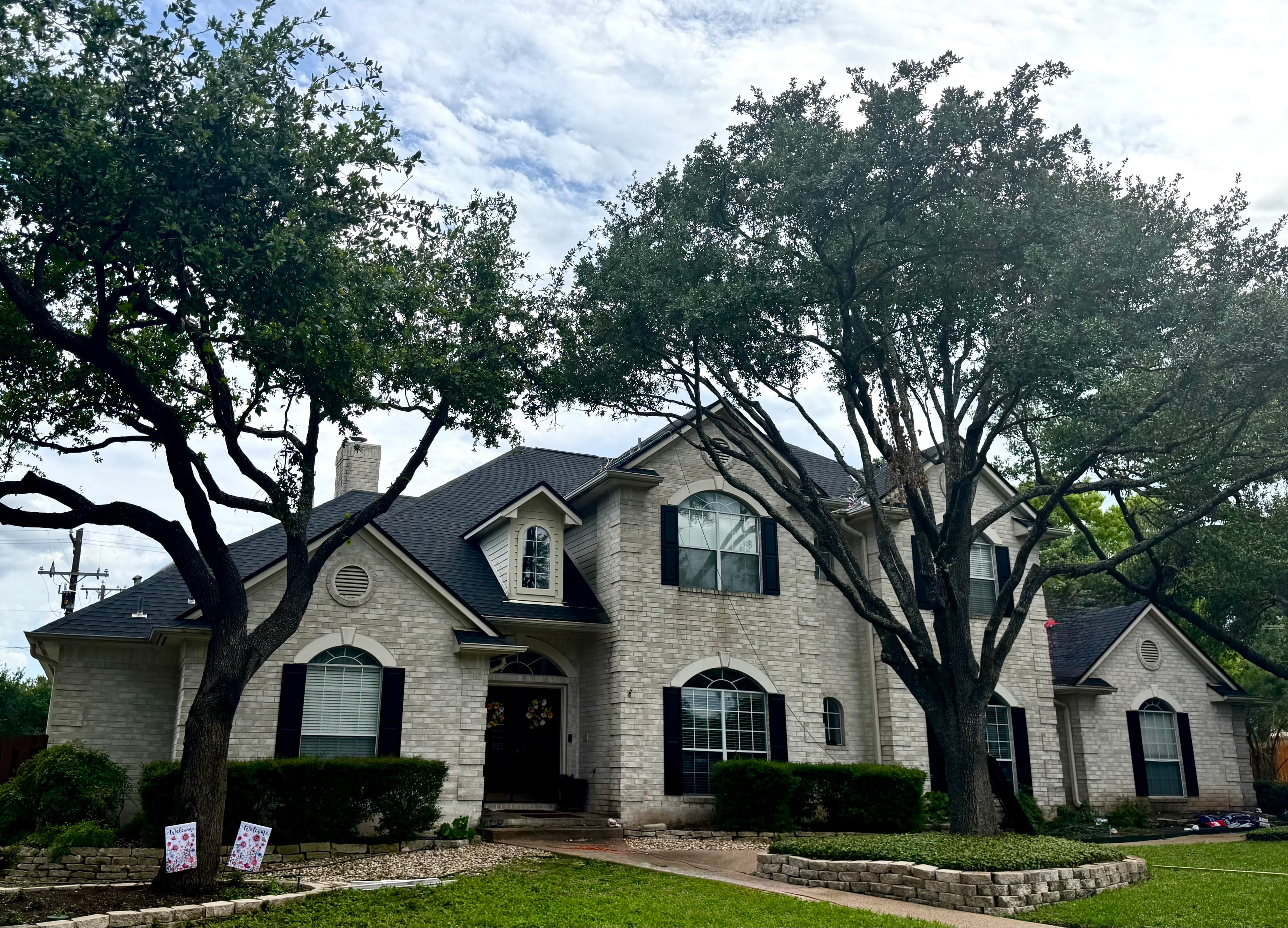
Berry Creek Roofing: Repair & Replacement in Georgetown
Busy rooflines, trees overhead and section-by-section rules. Where roofs like yours tend to leak, what the neighborhood’s hail record shows, and what to approve before a re-roof.
Berry Creek sits in northern Georgetown, near Hwy. 195 between Airport and Shell roads, in ZIP 78628. Its amenities include the private 18-hole golf course at Berry Creek Country Club, which a golf course directory lists as designed by Carl Doering in 1986, plus a fitness center, pool, park and clubhouse. The neighborhood is made up of several sections, and their HOA fees vary.
For a roofer, the telling detail is the builder list. Community Impact’s 2014 profile listed seventeen builders and its 2015 profile eight, from Steve Klein Custom Builder and Partners in Building to KB Home, Drees and Taylor Morrison. Many builders over the years means many styles of roof on the same street: different valleys, dormers, wall lines and add-ons, each with its own way of letting water in. If your home also sits under big trees, that changes what the roof needs again. We’ll tell you straight which of those applies to yours.
Multi-gable shingle roof with wall intersections
Roof-geometry guide
Where roofs like yours tend to leak
Every valley, wall and opening in a roof is a joint that has to be flashed, and joints are where most leaks start. Tick what your roof has to see what a proper inspection checks at each one. General roofing guidance, not a diagnosis.
Flashing failure or shingle failure?
Most leaks on a busy roof come from one of the two. These are the usual signs, not rules; an inspection is what settles it.
FlashingShingles
Where the stain is
Flashing: Next to something: a wall line, chimney, skylight, vent, dormer corner or along a valley's diagonal.
Shingles: Out in the open field of the ceiling, under a plain stretch of roof with nothing nearby.
When it leaks
Flashing: Mostly with wind from one direction, or in long soaking rain, and sometimes not at all in a calm storm.
Shingles: In most rains of any size once the shingle is broken through.
What shows outside
Flashing: Metal pulled away from a wall, cracked or dried sealant, rust, missing kick-outs or siding sitting on the shingles.
Shingles: Missing, creased or lifted tabs, bare spots where granules are gone, or bruises after hail.
What the fix involves
Flashing: Opening up the shingles around the feature, replacing or re-lapping the metal, then closing it back in.
Shingles: Replacing the damaged shingles and checking the slope around them for more of the same.
Valleys
A valley is where two roof slopes meet in an inside corner, so it carries the water from both. Leaks show up where that channel is cut short, worn through, or slowed down by debris.
What a proper inspection checks
How the valley is built (open metal, closed-cut or woven shingles) and whether that method was carried through cleanly
Shingle cuts along the valley line, and any nails driven too close to its center
Wear or exposed mat in the valley itself, which often ages faster than the open slopes
Leaves or grit dammed up in the channel
How it usually shows up: A valley leak usually stains the ceiling along a diagonal under the inside corner, and it gets worse in long, heavy rain rather than wind-driven rain.
A dormer puts small walls and two short valleys in the middle of a slope. Water has to get around its cheeks and the bottom corners where the dormer front meets the roof.
What a proper inspection checks
Step flashing up both dormer sides, one piece per shingle course
The lower corners, where side flashing and front apron flashing have to overlap correctly
Siding or trim on the dormer cheeks sitting clear of the shingles instead of buried in them
Both short valleys behind the dormer
How it usually shows up: Dormer leaks tend to show up as stains below the dormer's front corners or inside the dormer wall, not out in the open ceiling.
Chimney
A chimney is a box sticking through the roof. Water hits its uphill face, runs down both sides and has to be turned at the downhill corners.
What a proper inspection checks
Step flashing on the sides with counterflashing let into the masonry or covered by the siding above it
A cricket (a small diverter ridge) on the uphill side of a wider chimney
Mortar joints and caps where counterflashing is tucked in
Sealant used in place of metal, a common shortcut that dries out and opens up
How it usually shows up: Chimney leaks commonly track down the chimney chase or show on the ceiling right beside it, and can appear in some storms and not others depending on wind direction.
Skylight
A skylight is a hole in the deck with a curb around it. The curb flashing has to shed water on all four sides, and the uphill side catches the most.
What a proper inspection checks
The flashing kit around the curb, and whether it matches the skylight's design
The uphill side for debris build-up and water backing up
The glazing seal itself, separate from the roof around it
Condensation signs inside, which can look like a leak but aren't one
How it usually shows up: Water at a skylight that appears only in cool weather, or runs down the inside of the glass, is often condensation. Water staining the drywall well around the opening points to the flashing.
Where a steep slope breaks to a flatter one, water slows down as it crosses the transition, and the flatter section has less margin for wind-driven rain.
What a proper inspection checks
Whether the flatter section's material suits its slope
The transition line itself, which needs shingles or metal bent and lapped, not just butted
Granules and debris collecting where water slows
How it usually shows up: Leaks at a pitch change usually show directly under the transition line and follow heavy or wind-driven rain more than light showers.
Roof meets a wall
Anywhere a lower roof runs into a taller wall (a second story, a garage, a gable over a porch), water runs along the wall and must be turned out over the shingles.
What a proper inspection checks
Step flashing behind the siding or stucco along the whole wall line
Kick-out flashing at the bottom of the wall, so water lands in the gutter, not inside the wall
Siding or stone kept clear of the roof surface
Rot or swelling at the base of the wall above the roof line
How it usually shows up: A wall-line leak often shows up inside the wall or below the outside corner where the roof ends, sometimes far from where water first got in.
Tall trees overhead
Overhanging trees drop leaves, seed, pollen and twigs that pile up in valleys, behind chimneys and in gutters, and branches can scrape shingles in the wind. Shade keeps parts of the roof damp longer.
What a proper inspection checks
Debris dams in valleys and on the uphill side of anything that sticks through the roof
Gutters and downspouts flowing freely, so water isn't backing up under the roof edge
Scuffed or worn shingles under limbs, and any limb resting on the roof
Moss or algae on the shaded slopes
How it usually shows up: Tree-related leaks are usually drainage leaks: water backs up behind a dam of debris and comes in at a valley, a wall line or the roof edge, often after the first big rain following leaf drop.
Where a newer roof joins an older one, two different installs meet. The join line and any new valleys it creates are only as good as how the old roof was opened up and woven into.
What a proper inspection checks
The joint between the old and new roof sections, and how the shingles were lapped across it
Valleys created by the addition, and the flashing where its roof meets the original wall
Whether the two sections use matching underlayment and ventilation
Signs of sagging or a dip along the tie-in line
How it usually shows up: Tie-in leaks generally show along the line where the old and new ceilings meet, often as a straight stain rather than a round spot.
What to look at through the year when there's a canopy over the roof. General guidance for Central Texas homes, not a schedule your roof has to keep.
Shingle roof under overhanging branches
Spring
After the flowering and the first storms
From the ground
Look for catkins, seed and pollen piled in valleys and gutters once the trees finish flowering.
Check that downspouts are running clear during the first heavy spring rain.
Note any limb that has grown toward the roof over the winter.
For a pro: Spring storm season is the time to have valleys, wall lines and the uphill side of chimneys cleared and checked before debris has a chance to hold water.
Summer
Clearance and shade
From the ground
Watch for branches that now touch or hang just over the roof as the canopy fills out.
Look for dark streaks or green growth on slopes that stay shaded most of the day.
After a windy storm, scan for twigs or small limbs lying on the roof.
For a pro: Have an arborist handle any trimming near the roof. A roofer can then check the shingles under where the limbs were for scuffing and worn spots.
Fall leaf drop
When the gutters do the most work
From the ground
Clear gutters after the heaviest leaf fall, not before it, or you'll be doing it twice.
Look for leaves banked against chimneys, dormers and skylight curbs.
Depending on the trees overhead, leaf drop may not be limited to fall, so repeat the check when your trees actually shed.
For a pro: If leaves sit on the roof itself, a professional clean of the valleys and flashings is safer than a ladder and a blower, and it doubles as an inspection.
After any storm
Limbs, hail and wind
From the ground
Don't climb up. From the ground, look for limbs on the roof, shingles in the yard and dents in gutters or vents.
Photograph anything you see, with the date, before anything is moved.
Check the attic and top-floor ceilings for new stains over the next few rains.
For a pro: Get an inspection before you decide anything about a claim. A limb strike can break decking that looks fine from the street, and hail bruises don't show from the ground.
Every hail report of 1 inch or larger (the National Weather Service's severe threshold) filed within 5 miles of the Berry Creek Country Club address, from July 2005 (where the archive's record for this area begins) to today.
2005 to 2026 (year to date). Busiest year: 2019, with 4 reports. Counts are individual reports, not storms: one storm can produce several reports from different observers.
The 10 largest hail days on record
Largest report each day, distance from the record’s center.
Date
Hail size
Distance
May 2, 2007
2.75"
4.1 mi
May 28, 2020
2.00"
3.5 mi
Jun 9, 2019
2.00"
3 mi
Sep 24, 2023
1.75"
2.6 mi
Oct 15, 2019
1.75"
4 mi
Mar 19, 2013
1.50"
3.5 mi
May 9, 2024
1.25"
2.5 mi
Jun 16, 2019
1.25"
4.1 mi
Apr 13, 2018
1.00"
4.6 mi
Apr 2, 2017
1.00"
4.1 mi
Map loads as you scroll
Green marker: the Berry Creek Country Club address, the record’s center. Dots: reports of 1″ or larger, colored by size. Dashed ring: 5 miles.
Every hail report in the record (57)
Newest first, with each report’s distance from the Berry Creek Country Club address. Reports of 1″ or larger are marked. The location is the National Weather Service’s own description of where it was reported.
Date
Size
Distance
Reported location
May 21, 2026
0.75"
3.5 mi
3 W Weir
May 10, 2026
0.75"
4.4 mi
4 NW Serenada
May 9, 2026
0.75"
4.8 mi
4 WNW Serenada
Apr 30, 2025
0.75"
3.5 mi
3 W Weir
Apr 30, 2025
0.50"
1.9 mi
1 SE Serenada
Mar 23, 2025
0.75"
4.9 mi
1 W Georgetown
Mar 23, 2025
0.75"
4.6 mi
1 S Georgetown
Mar 23, 2025
0.50"
0.7 mi
2 E Serenada
Mar 23, 2025
0.75"
1.1 mi
2 N Serenada
Mar 23, 2025
0.50"
3.4 mi
1 NW Georgetown
Mar 23, 2025
0.75"
1.1 mi
2 N Serenada
Dec 7, 2024
0.50"
2.6 mi
2 NE Georgetown
May 9, 2024
1.00"1″+
0.7 mi
2 E Serenada
May 9, 2024
1.25"1″+
2.5 mi
2 NW Serenada
May 9, 2024
1.00"1″+
4.1 mi
Georgetown
Sep 24, 2023
1.00"1″+
1.3 mi
2 ESE SERENADA
Sep 24, 2023
1.75"1″+
2.6 mi
1 SW SERENADA
Sep 24, 2023
1.00"1″+
3.5 mi
3 W WEIR
Sep 24, 2023
1.00"1″+
3.1 mi
1 ENE GEORGETOWN DAM
Sep 24, 2023
0.70"
2.6 mi
3 N SERENADA
Sep 24, 2023
0.88"
0.8 mi
2 E SERENADA
Mar 21, 2022
0.88"
4.6 mi
1 SE GEORGETOWN
Jun 2, 2021
0.50"
4.9 mi
2 SW WEIR
May 28, 2020
1.00"1″+
3.1 mi
2 NW SERENADA
May 28, 2020
2.00"1″+
3.5 mi
2 WNW SERENADA
May 28, 2020
2.00"1″+
0.7 mi
2 ENE SERENADA
May 28, 2020
1.00"1″+
4.1 mi
3 N GEORGETOWN DAM
Jan 10, 2020
0.75"
0.7 mi
2 E SERENADA
Oct 15, 2019
1.75"1″+
4 mi
1 ENE GEORGETOWN
Oct 15, 2019
1.75"1″+
4 mi
1 ENE GEORGETOWN
Jun 16, 2019
0.70"
1.9 mi
2 SE SERENADA
Jun 16, 2019
0.88"
4.8 mi
GEORGETOWN
Jun 16, 2019
1.25"1″+
4.1 mi
GEORGETOWN
Jun 9, 2019
2.00"1″+
3 mi
4 NNE SERENADA
Apr 13, 2018
1.00"1″+
4.6 mi
1 ESE GEORGETOWN
Feb 11, 2018
0.25"
4.8 mi
1 SSW GEORGETOWN
Apr 29, 2017
0.50"
2.2 mi
3 NE GEORGETOWN
Apr 29, 2017
0.25"
1.3 mi
4 NNE GEORGETOWN
Apr 2, 2017
0.75"
4.1 mi
GEORGETOWN
Apr 2, 2017
0.50"
3.5 mi
SUN CITY
Apr 2, 2017
1.00"1″+
4.1 mi
GEORGETOWN
Apr 9, 2016
0.25"
4.1 mi
GEORGETOWN
Feb 6, 2016
0.25"
0.2 mi
2 NE SERENADA
Apr 6, 2014
0.25"
0.2 mi
2 NE SERENADA
Apr 6, 2014
0.70"
4.1 mi
GEORGETOWN
Apr 6, 2014
0.25"
4.1 mi
GEORGETOWN
Apr 27, 2013
0.25"
4.3 mi
1 W SUN CITY
Mar 19, 2013
1.00"1″+
4.9 mi
4 E GEORGETOWN
Mar 19, 2013
1.00"1″+
4.1 mi
GEORGETOWN
Mar 19, 2013
0.88"
3.5 mi
SUN CITY
Mar 19, 2013
1.50"1″+
3.5 mi
SUN CITY
Mar 19, 2013
0.50"
2.9 mi
5 NNW GEORGETOWN
Nov 26, 2012
0.50"
2.9 mi
5 NNW GEORGETOWN
Mar 5, 2011
0.50"
4.9 mi
2 W GEORGETOWN
Apr 4, 2008
1.00"1″+
3.4 mi
1 N GEORGETOWN
Apr 4, 2008
0.88"
2.2 mi
4 NE GEORGETOWN
May 2, 2007
2.75"1″+
4.1 mi
GEORGETOWN
These are reports within about 5 miles, not findings of damage at any address.
Each one records hail that someone (a trained spotter, law enforcement, the media or the public) reported at one place and time; it doesn’t show what fell on a particular roof. They are preliminary National Weather Service Local Storm Reports as archived by the Iowa Environmental Mesonet, which notes its archive is not complete or official. NOAA’s official storm record is published in the NOAA Storm Events Database. Dates are Central time.
We’ll look for hail, wind, and tornado reports within 1 mile of this address over the last 5 years, using National Weather Service local storm reports.
Narrow it to your street
The record above covers 5 miles around the country club. This lookup checks reports within 1 mile of your home over the last 5 years.
Enter your street address followed by Georgetown, TX 78628.
Our Sun City Texas page keeps a record centered about 2.7 miles west-northwest of here with a 10-mile radius, so it takes in this whole circle and the wider area around it.
Build-era guide
Same street, different decades of roof
Next door’s new roof says nothing about yours. Pick the decade your house was built to see what that usually means for the roof on it, and what the storm record holds since then.
When was your house built?
Use the year the house was built. If you know your roof was replaced, the storm line in each panel tells you to count from that year instead.
Built before 2000
Probably not the first roof, so learn its history
A house built before 2000 has been through enough Central Texas summers that it may well be on its second roof or later. That makes the questions about the roof you have now more useful than the house's age.
Questions to answer first
1When was the current roof installed, and do you have the invoice or warranty?
2Was the old roof torn off, or is there more than one layer up there?
3Were the flashings replaced at the last re-roof, or reused?
On the inspection
Expect the inspector to count layers at the roof edge, look at the decking from the attic, and check whether older ventilation was brought up to date. The City requires a tear-off when a roof already has two or more layers.
The record starts in July 2005, so it can't speak to this house's earlier years. From then on it holds 22 reports of 1 inch or larger within about 5 miles; if the roof has been replaced, count from the replacement year instead.
Built in the 2000s
First roof or first replacement
A house from the 2000s could still have the roof it was built with, or one replacement. Which one it is changes everything about what comes next, and a purchase inspection or old paperwork often answers it.
Questions to answer first
1Is this the original roof? If you bought the house, check your inspection report.
2Has it had storm repairs? Patched areas don't always match the rest.
3What did the builder use in the valleys and at the wall lines?
On the inspection
Expect attention to the original builder details: valley method, wall-line step flashing and pipe boots, which are often the first parts of a roof this age to need work.
The record starts in July 2005, so it can't speak to this house's earlier years. From then on it holds 22 reports of 1 inch or larger within about 5 miles; if the roof has been replaced, count from the replacement year instead.
Built in the 2010s
Likely the builder's roof, mid-life
A house built in the 2010s is often still on the roof it was built with. If so, it should have life left, and the job is finding storm damage and installation shortcuts while they're cheap to fix.
Questions to answer first
1Do you have the builder's roofing paperwork or the shingle manufacturer's warranty registration?
2Has anyone been on the roof since you moved in, for solar, satellite or HVAC work?
3Have any trees grown up over the roof since the house was built?
On the inspection
Expect a slope-by-slope look for hail bruising and lifted tabs, plus the wall lines and kick-outs builders sometimes skip.
From January 2010 on, the record holds 20 reports of 1 inch or larger within about 5 miles. If your roof is the one the house was built with, that is its whole storm history on record.
Built in the 2020s
A new house, a new roof, and your paperwork
A house built in the 2020s has a new roof, which should mean few problems. What matters most now is the paperwork: builder warranty, manufacturer warranty and photos of the roof as delivered.
Questions to answer first
1What does the builder's warranty cover on the roof, and for how long?
2Is the shingle warranty registered, and is it in your name?
3Did the roof come with any punch-list items that were never closed?
On the inspection
Expect a check that shingles sealed down, that flashing was installed at every wall and penetration, and that nothing was damaged by trades who worked on the roof after the shingles went on.
From January 2020 on, the record holds 11 reports of 1 inch or larger within about 5 miles. If your roof is the one the house was built with, that is its whole storm history on record.
General guidance by the decade a house was built. Your roof’s actual condition only shows on an inspection.
Before work starts
Two approvals for a Berry Creek re-roof
Your section's architectural review covers the roof itself; the City permits the work. Rules and fees can differ by section, so start by finding out which documents govern your lot.
1
Step 1
Your section's architectural review
Berry Creek has several sections, and Community Impact reported in 2015 that their HOA fees vary. The recorded rules we could read belong to one association, Berry Creek (Austin) Homeowners Association, Inc., which its own recorded policy manual says was established under the declaration for Berry Creek Section Five, Phase Two. For lots under that declaration:
No structure or improvement may be placed or altered until the Architectural Control Committee approves the plans in writing. Plans cover exterior materials, colors and elevation, including roof type and color.Declaration Art. II.B
Roofs must be dimensional shingles with at least a 30-year warranty.Art. III.D
If the Committee neither approves nor rejects plans within 30 days of receiving everything it asked for, approval is presumed. An approval is good for three months; if work hasn't started by then, resubmit.Art. II.E, II.G
The Committee may not prohibit wind- and hail-resistant shingles that resemble the shingles used in the community, are more durable and of equal or better quality, and match the look of neighboring homes. They still go through review.Policy Manual, Att. 6
The association's online request form asks for a detailed list of materials, including shingle type, and a copy of your plat. It estimates about 21 days with a complete submission and says the Committee will act within 30 days of receipt.ACC form
The same form says Committee approval doesn't override City or County codes.ACC form
If your home isn't in Section Five, Phase Two, these may not be your rules: fees and requirements can differ by section. Ask which declaration and committee govern your lot before you apply, and read the current documents, which can be amended.
Per the City's roofing permit page (undated; confirm current fees and steps with the City):
A permit is required for a new roof within the City Limits of Georgetown.
Contractors register with the City and apply online through MGO Connect (www.mgoconnect.org).
The permit costs $60.00.
The City estimates ten to fifteen business days for processing.
After installation, a roof final inspection is requested online.
The existing covering must be torn off first when the roof is water-soaked or deteriorated, has wood shake, slate, clay or cement tile, or already has two or more layers.
The City's page says nothing about HOA approval, and the association's form says its approval doesn't replace City codes, so plan on both. Every Berry Creek point we checked falls inside the City Limits on the City's own map, but whether your parcel does is the City's call.
The Berry Creek HOA site posts its governing documents and an architectural request form. We couldn’t find published guidelines for other sections; if your section has its own association, ask it for them. We’ll bring shingle specs and samples for your application.
Storm seasons
Georgetown storm seasons and the contractor questions that follow
A big hail year means a lot of roofing work in Georgetown at once. Here is what has actually been reported, and what to check before you sign with anyone.
May 2020 · City permit records
A normal year's permits, many times over
Georgetown normally issues about 400 re-roofing permits a year. After a May 2020 hailstorm it issued 5,488, according to City records reported by Community Impact in July 2021.
FOX San Antonio reported a storm that hit south and southeast Georgetown and east Round Rock, naming the Saddle Creek neighborhood as hard-hit. A local roofing company's president estimated 40,000 to 50,000 homes were affected; that is his estimate, not a count. The article didn't report hail size, and it didn't name Berry Creek.
Neither report says anything about a particular Berry Creek roof. The storm record above lists what has been reported within 5 miles; only an inspection can say what reached yours.
Before you sign with anyone after a storm
1
No deals on your deductible
Texas law says you pay your own deductible. A contractor who promises or agrees to pay, waive, absorb or rebate it without your insurer's consent commits a Class B misdemeanor, and your insurer can hold back the replacement-cost payment until you show you paid it.
The Texas Department of Insurance says not to pay in full up front, to be wary of a large down payment, and not to make the final payment until the work is done.
Pay against a written contract and invoice. TDI warns never to sign a contract saying you agree to the repairs “for the value of the insurance proceeds”; the City's re-roof page says that means giving the contractor every penny the insurer pays.
Roofing contractors register with the City of Georgetown, at no cost. The City's re-roof page links its list of currently registered roofing contractors, labelled as of August 1, 2026. The City also says the owner stays responsible for finishing permits and inspections, even if a contractor walks away from the job.
Offered a deal on your deductible? The Texas Department of Insurance says to report it to the Texas Attorney General at 800-621-0508.
Berry Creek roofing FAQ
Look at the legal description on your deed or title policy: it names the recorded subdivision, usually as Berry Creek (sometimes written "Berry Crk") with a section or phase number, or as a named subdivision such as Woods at Berry Creek or Reserve at Berry Creek. The City of Georgetown's online map also has a subdivision layer drawn from appraisal district data. Knowing your section matters because Berry Creek's sections have different HOA fees and can have different recorded rules.
Plan on it, and confirm with your association. For lots under the Section Five, Phase Two declaration, no improvement may be placed or altered until the Architectural Control Committee approves the plans in writing, and the plans include roof type and color (Art. II.B). Roofs there must be dimensional shingles with at least a 30-year warranty (Art. III.D). The association's online request form lists roof replacement as a project type and says the Committee must approve any exterior modification before work begins. Other sections may be governed by different documents, so ask which ones apply to your lot.
Because most of what goes wrong is about drainage and contact, not age. Leaves and seed pile up in valleys and behind chimneys and hold water against the flashing, gutters overflow back under the roof edge, branches scuff shingles in the wind, and shaded slopes stay damp longer. An inspection for a tree-covered roof spends its time on those spots, and on any limb that has rested on or struck the roof.
Start with where the stain is. A stain next to a wall, chimney, skylight, vent or along a valley usually points to flashing; a stain in the middle of a plain stretch of ceiling usually points to the shingles above it. A leak that only shows with wind from one direction is often flashing too. The roof-geometry guide on this page lays out the signs side by side, but an inspection is what confirms it.
Every point we checked across Berry Creek, including the country club address, falls inside the City Limits on the City of Georgetown's own map, and the City's roofing permit page says a permit is required for a new roof within the City Limits. The contractor registers with the City, applies online through MGO Connect, pays $60.00, and requests a final inspection when the roof is done. The City's page is undated and a map check isn't a parcel ruling, so confirm your parcel and the current steps with the City.
Yes. Berry Creek is in northern Georgetown, and we're a Georgetown-based roofing contractor serving Georgetown and the I-35 corridor. Call (512) 818-5922 or request a free inspection through our contact page.
It lists hail reports within 5 miles of the Berry Creek Country Club address from the archived National Weather Service Local Storm Reports, with each report's date, size and distance. It shows how often hail of a given size has been reported around the neighborhood since the archive's record for this area begins. It doesn't show what fell on your roof, it isn't a finding of damage at any address, and the archive itself says it isn't complete or official. Only an inspection of your roof can show damage.
The Texas Department of Insurance says to file as soon as you can if hail or strong winds damaged your home. Take pictures and video of the damage first, cover holes to keep the rain out and save the receipts, since your policy may pay for temporary repairs, and don't throw damaged items away until your insurance company tells you to. Your policy sets its own reporting deadlines, so read it or ask your agent.
No. The City's re-roof page passes on the Texas Department of Insurance's advice: never sign anything before letting a contractor on your roof to estimate repairs, never sign a contract with blanks on it, and be wary of anyone who only has out-of-town references or solicits door to door. Get written estimates on company letterhead, more than one bid, and check the company against the City's list of registered roofing contractors before you sign.
You are, according to the City. Its re-roof page says the contractor coordinates the work and inspections, but the current property owner, and any future owner, is ultimately responsible for making sure permitting and inspections were completed, even if a contractor abandons a permitted project or is let go. Ask your roofer for the permit number and the result of the roof final inspection, which is requested online after installation.
Replacing anyway?
A roof replaced through an insurance claim may qualify for Class 4 impact-resistant shingles at no additional upgrade charge. Berry Creek (Austin) HOA's recorded policy says its reviewer can't prohibit hail-resistant shingles that meet its look-alike test.
Used for: Every storm figure on this page: the yearly chart, largest and most recent reports, the full report list with distances, the map and the build-era counts.
IEM states its archive is not complete or official.
Used for: Location near Hwy. 195 between Airport and Shell roads; several sections with varying HOA fees; private golf course, fitness center, pool, park and clubhouse; builders named in the intro.
City of Georgetown (data from Williamson Central Appraisal District)
Used for: That the recorded subdivision names include numbered Berry Creek sections and phases, some abbreviated “Berry Crk”, and that the center point sits among them.
The layer says it is downloaded quarterly from the appraisal district.
Berry Creek (Austin) Homeowners Association, Inc., Doc. No. 2016036708
Used for: That the association was established under the Section Five, Phase Two declaration, and its energy-efficient roofing materials policy (Attachment 6).
Used for: The April 2025 storm as reported: Tuesday night (April 22), south and southeast Georgetown and east Round Rock, the Saddle Creek neighborhood named, and a roofing company president's estimate of 40,000 to 50,000 homes affected.
The article does not name Berry Creek and does not report hail size. The homes figure is one person's estimate.
Used for: The registered roofing contractor list, the owner's responsibility for permits and inspections, and the TDI tips the City repeats (don't sign before a roof estimate or with blanks, door-to-door and out-of-town references, the insurance-proceeds warning).
Undated page. Its list of registered roofing contractors is labelled as of 8.1.2026.
Texas Legislature, 86th Regular Session, effective September 1, 2019
Used for: The deductible protection: you must pay it (§707.002), the insurer may withhold replacement-cost payments until you show proof (§707.004), and the offense and penalty (§27.02(c), (d)).
Read in the enrolled bill. TDI's roofing law page (updated March 24, 2025) cites the same sections.
Texas Department of Insurance, last updated December 9, 2025
Used for: The claim-timing FAQ: file as soon as you can, photograph the damage, make temporary repairs and keep receipts, and keep damaged items until the insurer says otherwise.
Checked October 24, 2026
Let's look at your Berry Creek roof
Free, no-obligation inspections. We'll check the valleys, walls and flashings, document what we find, and give you a straight answer.